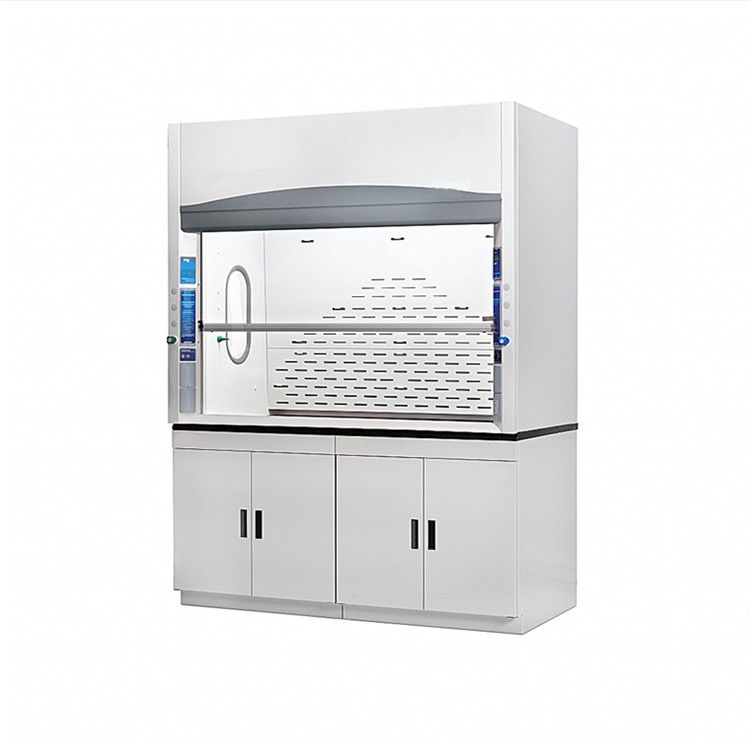
A fume hood is typically a large piece of equipment enclosing five sides of a work area, the bottom of which is most commonly located at a standing work height.
Two main types exist, ducted and recirculating (ductless). The principle is the same for both types: air is drawn in from the front (open) side of the cabinet, and either expelled outside the building or made safe through filtration and fed back into the room.
Safety Note: Only provide personal protection. No HEPA filters to remove biological agents. Contaminates reduced to acceptable levels by dilution with environmental air.
| Item | GCC-FH-1200 | GCC-FH-1500 | GCC-FH-1800 |
| Internal Size | L000*W700*H2350mm | L1300*W700*H2350mm | L1600*W700*H2350mm |
| External Size | L1200*W800*H700mm | L1500*W800*H700mm | L1800*W800*H700mm |
| Wind Speed | 0.3~0.8m/s | ||
| Noise | <65dB | ||
| Air Flow | 1200m³/h | 1800m³/h | 2300m³/h |
| Efficiency | 99.99%@0.3μm | ||
| Voltage | 220V/50Hz | ||
Our fume hoods are made entirely of high-quality polypropylene (PP), which is acid-resistant, alkali-resistant, and corrosion-proof—ideal for harsh chemical environments.
No. Fume hoods provide only chemical protection.
They do not use HEPA filters and cannot protect against biological agents.
For biological protection, please use a biosafety cabinet (BSC).
The face velocity is 0.3–0.8 m/s, meeting international laboratory ventilation safety requirements.
We can provide both:
Ducted type: Connects to building exhaust.
Ductless type: Uses activated carbon filtration.
You can choose based on your laboratory design.
We offer three standard models:
1200 mm (GCC-FH-1200)
1500 mm (GCC-FH-1500)
1800 mm (GCC-FH-1800)
Custom sizes are also available upon request.
Overall Rating
Rating Snapshot
The following is the distribution of all ratingsAll Reviews